A ninety-day no-spend stretch, and how the journal sets it up
How The 90 Day No-Spend Journal structures ninety days: your own rules, a daily spending log, the 90-day path, weekly reviews and two checkpoints.
A no-spend stretch is easy to decide on and hard to keep track of. You say you will not buy anything you do not need for a while, and then a coffee, a subscription and a “just this once” arrive in the same week. The 90 Day No-Spend Journal is built around that problem. It is not a budget app. It is a paper record of what you spend and why, for ninety days, and it makes no promise about what the total will be.
This is how the book sets the stretch up, from the first pages to day 90.
Before day 1: decide before the shop does
The first pages are filled in once, before you start. They ask for:
- Your real hourly rate, so that a price can be read as hours of work.
- The 90-day rules. One page holds three lists: a green list of what is allowed because you truly need it, an orange list of what is allowed within a limit you set now, and a red list of what is not bought for ninety days.
- What you already own, on a page the book calls Forgotten value, with a pantry and freezer list.
- Your sneaky leaks, the small recurring spending you stop noticing.
- Your why, and a few starting numbers, with columns for day 1, day 30, day 60 and day 90.
The rules are written in advance on purpose. Deciding what is allowed while you are calm is easier than deciding in the checkout queue. And the book is clear that no-spend does not mean spending nothing for ninety days: the green list is allowed. What counts as a no-spend day is your decision, made once, before you start.
The daily spread
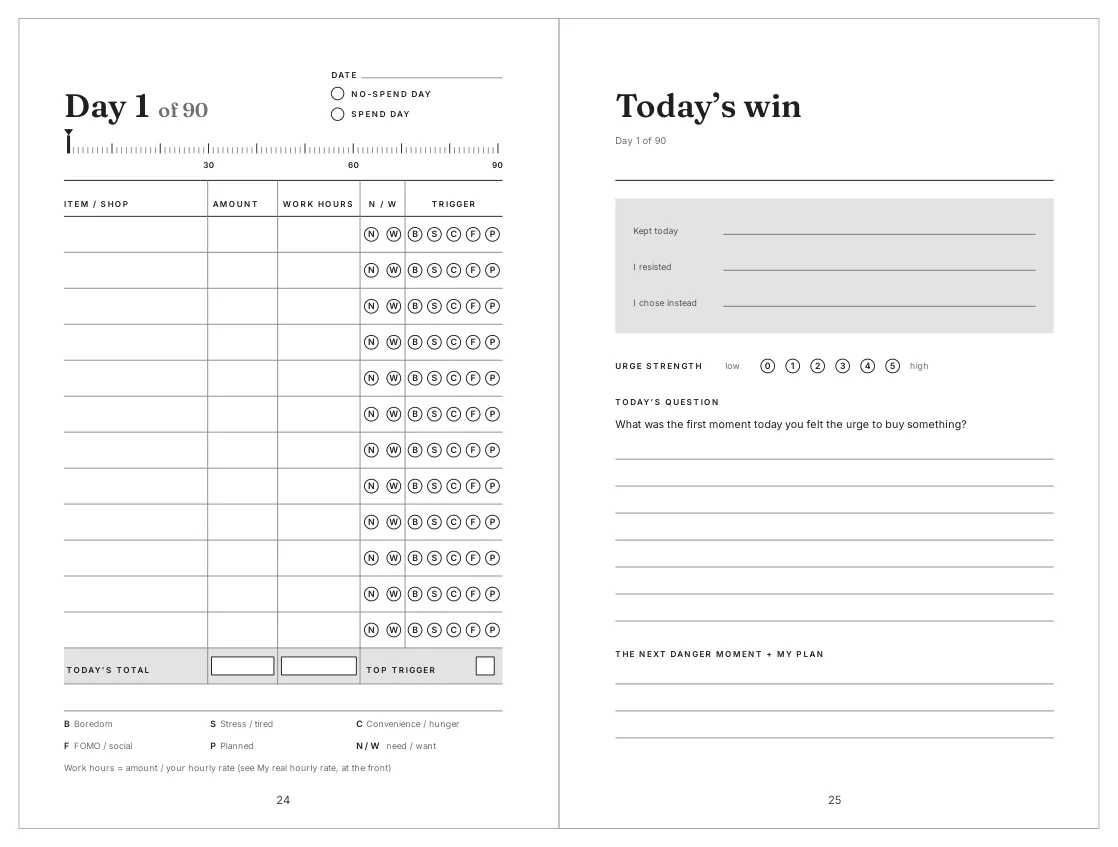
Every day is a two-page spread.
The left page is the log. It has a line for the date, two circles to mark the day as a no-spend day or a spend day, and a row of lines for every purchase: the item or shop, the amount, and the work hours it represents. You circle N for need or W for want, and then one letter for the trigger: B for boredom, S for stress or tiredness, C for convenience or hunger, F for fear of missing out or social pressure, and P for planned. At the bottom is today’s total and your top trigger.
The right page is called Today’s win. It asks what you kept today, what you resisted, and what you chose instead. Then you rate the strength of the urge from 0 to 5, answer the day’s question, and write the next danger moment and your plan for it.
The questions are the part many people remember. There are ninety of them, one a day. Day 1 asks, “What was the first moment today you felt the urge to buy something?” Others ask which shop or app is hardest to walk past, at what time of day spending creeps in, and what else could fill the time you spend browsing.
What was the first moment today you felt the urge to buy something?
The 90-day path
The no-spend or spend circle on each day’s page is your record. The book adds a path of ninety circles, drawn like a winding road, and you shade circle N when day N was a no-spend day. A spend day leaves its circle empty. The book’s wording is “no guilt, no reset”: the day number does not go back to one, and tomorrow is the next spread.
Every seven days: the weekly review
After day 7, 14, 21 and so on, a weekly review spread adds up the week: your numbers, your triggers, your wins and what got in the way. Its right page, “Bingo & fridge”, has a free-richer bingo card and a 72-hour impulse fridge. In the fridge you write down what you want to buy, wait three days, and then circle yes or no. A want written down is easier to look at in three days than in three minutes.
Day 30 and day 60: the checkpoints
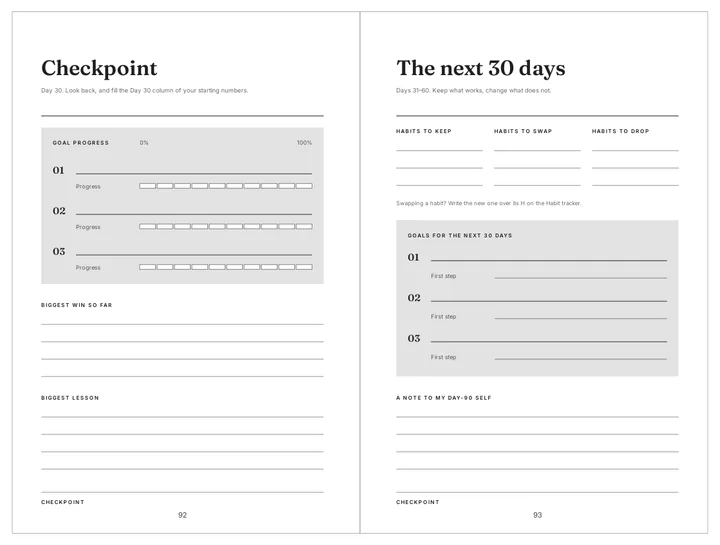
At each checkpoint the journal asks you to add up what you kept, see which of your rules held, find your dominant triggers, and write the rules for the next thirty days. If a rule did not work, you change it here. That is part of the design.
Day 90: what is your money for?
The final pages, Look back and Look ahead, compare your first pages with your last and end by asking you to decide what your money is for next. There is no target at the end and no verdict.
Missed a day?
Leave it blank and pick up today, as in the other journals of the series. On a hard day the book suggests writing only what the later pages count, and leaving the rest.
What it is not
The journal tracks spending and the habits around it. It is not financial advice, and it does not tell you how much to save or what to cut. Its job is smaller: to make ninety days of choices visible, in your own handwriting, so you can see them.