Getting ready for a doctor's appointment with a health journal
How a neutral written record of readings, medicines, how you felt and your questions can make an appointment easier. And what a journal does not do.
Appointments are short and memory is unreliable. It is easy to remember the one morning that worried you and lose the ordinary ones around it. A written record is a calm way to bring the whole picture. This article is about preparing that record. It is not about interpreting it, which is for you and your care team.
A neutral record, not an interpretation
The health journals in the 90 Day Journals series are built on one idea: they keep a neutral record for you and your care team. What you measured, what you took, how the day went. They give no medical advice, no doses and no target values.
Anything that is a limit or an instruction is a blank for you to fill in with what your own care team told you. So the journal helps you bring accurate facts. It does not tell you what they mean.
What is worth bringing
Whatever you track, a useful record usually answers four questions:
- What were my readings, measured the same way each time?
- What did I take, and when? Which doses did I miss?
- How did I feel, and what was going on that day?
- What do I want to ask?
Write the questions down before the visit, not in the waiting room. Put the most important ones first, in case time runs short.
How three of the journals help
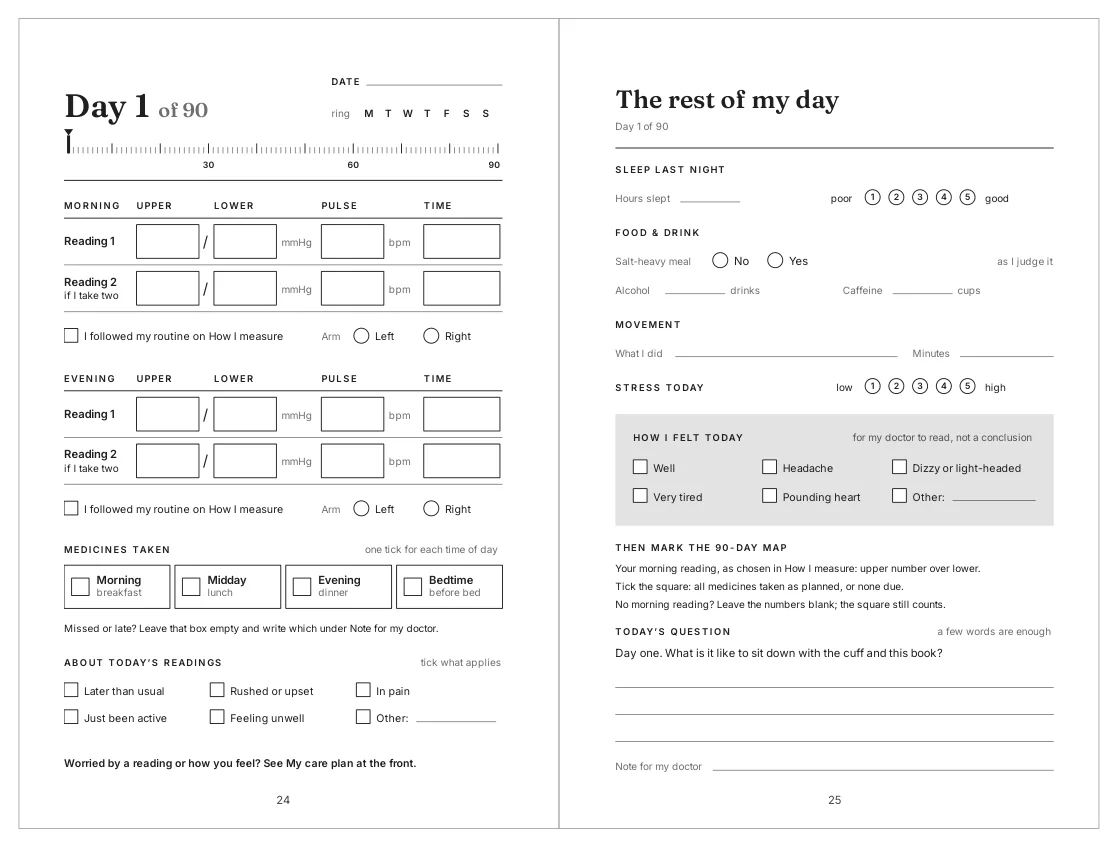
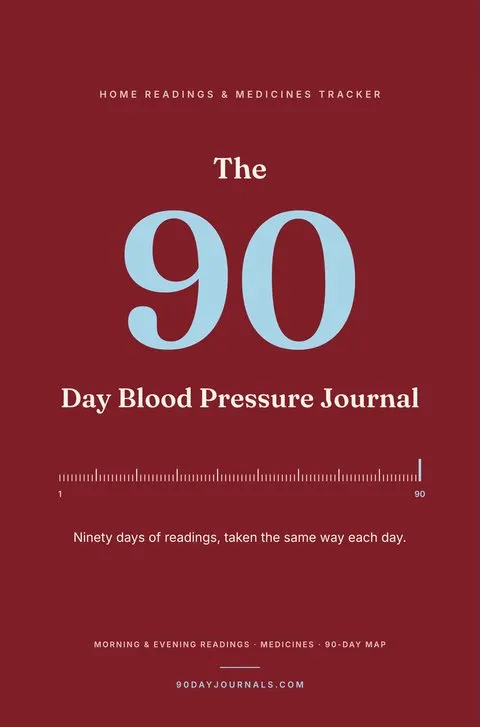
Blood pressure. The 90 Day Blood Pressure Journal has you write each reading as three numbers, upper, lower and pulse, with the time. You tick that you followed your measuring routine, ring the arm, and tick your medicines once for each time of day. A second page each day holds plain facts about the rest of your day: sleep, a salt-heavy meal, alcohol, caffeine, movement, stress and how you felt. At the front, a 90-day map keeps every morning reading on one page. After day 30 and day 60 there is a month page and a page for your questions. After day 90 there is a one-page Summary for my doctor. It counts, and does not average: mornings measured, days all medicines were taken as planned, and your highest and lowest morning reading.
Blood sugar. The 90 Day Blood Sugar Journal is laid out for the days between two blood tests. Its first pages are filled in with your doctor or nurse: your unit (mg/dL or mmol/L), your testing plan and your own targets. Each day holds your fasting number and the meals you test, before and after. Check-in pages after day 30, 60 and 90 collect your numbers, any lab results and your three most important questions.
Cardiac recovery. The 90 Day Cardiac Recovery Journal starts with pages for your heart profile, your care team and a medication card, filled in with your doctor or rehab nurse. Each day you log blood pressure, heart rate, weight, side effects and a tick for each dose. If you miss a dose, leave that box empty and name it in your note for the doctor. Visit pages on days 30, 60 and 90 hold your numbers, side effects and three most important questions.
The other health journals in the series follow the same principle, each laid out for its own topic.
A simple routine for the weeks before
- Record the same way each time. The first pages ask how and when you measure. Fill them in once, with your care team, and keep to it.
- Leave gaps as gaps. A day without a reading stays blank. Nothing needs catching up, and a blank is honest information.
- Collect questions as they come. Write them on the day you have them, not on the night before the visit.
- Take the whole book. Open it at the month page or the summary, and let the pages answer the “how has it been?” question.
During and after the visit
Ask for instructions in your care team’s own words and write them in while you are there: the range they want you to use, how often to measure, when to call, and when to get urgent help. The blood pressure journal has blank lines for exactly this on its care plan page, and a place to write what your doctor said and what you agreed. If a medicine is started or changed, write the date next to it.
What a journal does not do
It does not diagnose, and it does not tell you what a number means. It does not replace your doctor, your pharmacist or emergency care. Never change a medicine or a dose because of what you wrote in it.
If something feels like an emergency, do not stop to write it down first. Call your local emergency number, and log it afterwards. If measuring every day is making you anxious, say so to your care team. How often to measure, and for how long, is their decision.
The journals are 6 x 9 in paperbacks, sold on Amazon (listings coming soon).