How to use the day-30 checkpoint in a 90 day journal
After day 30 the journal stops you for a checkpoint. What the two pages ask, a sensible order to fill them in, and how to keep, swap or drop a habit.
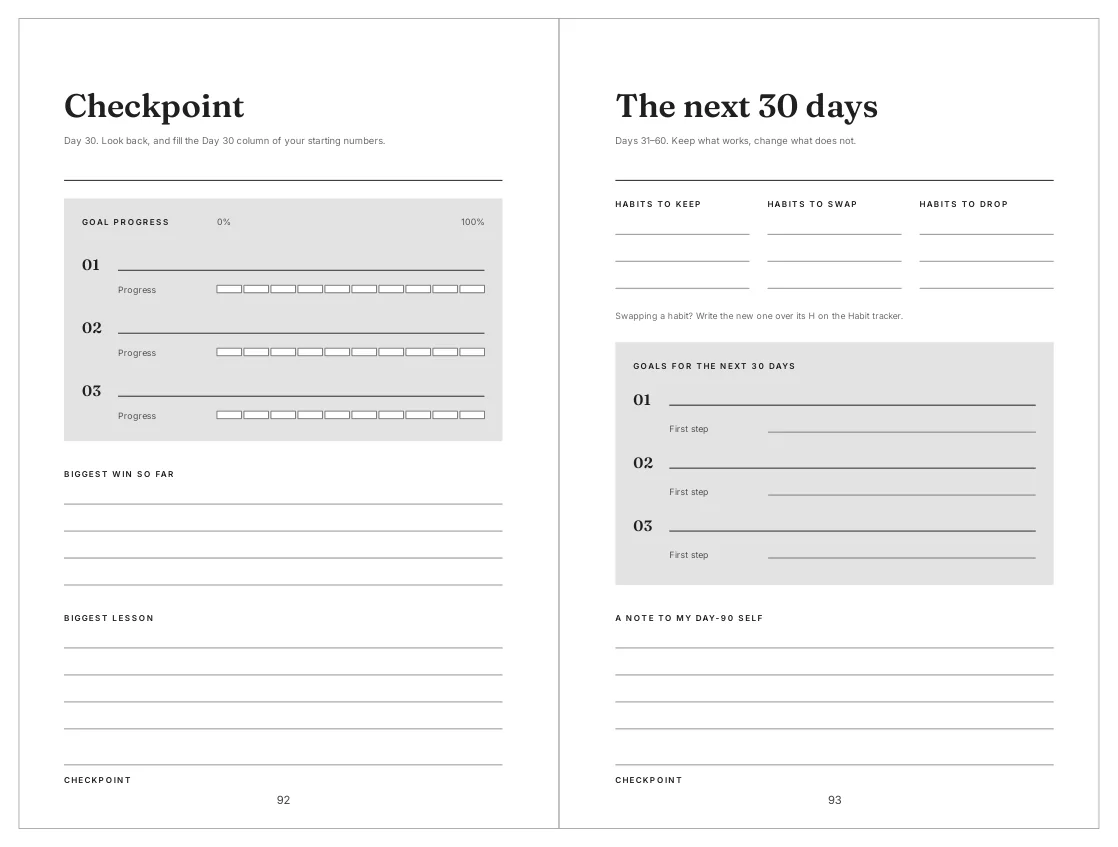

Thirty days in, the journal stops asking for a day and asks for a decision. The checkpoint is a two-page spread that comes straight after day 30, and again after day 60. It is the place where you look at what you have actually done and change the plan if it needs changing. This is how it works in The 90 Day Journal, and how to get through it in one sitting.
What the two pages are
The left page is called Checkpoint, with the note “Day 30. Look back, and fill the Day 30 column of your starting numbers.” It has:
- Goal progress, one row for each of your three goals, with ten small boxes to shade from 0% to 100%.
- Biggest win so far, four lines.
- Biggest lesson, five lines.
The right page is called The next 30 days, with the note “Days 31 to 60. Keep what works, change what does not.” It has:
- Habits to keep, Habits to swap and Habits to drop, three lines each.
- Goals for the next 30 days, three numbered goals, each with a First step line.
- A note to my day-90 self, five lines.
A small reminder sits under the habit columns: swapping a habit means writing the new one over its H on the Habit tracker.
Start with the numbers, not the feelings
The checkpoint is easier if you collect the facts first. Before you write anything:
- Fill the Day 30 column of Starting numbers. These are the things you chose to measure before day 1. Read across each row, from Day 1 to Day 30.
- Look at the Habit tracker. Thirty days are filled in, so two blocks of it are complete. The book’s own note for this stretch says that may be enough to show whether there is a habit you named but never really started.
- Skim the four weekly reviews. After days 7, 14, 21 and 28 you wrote down wins, what got in the way and what you would do differently. Read the left pages in one go and see what comes up more than once.
Only then shade the goal bars. It is much harder to be honest about a goal’s progress from memory than from a page of your own notes.
Shading the goal bars
There is no rule for how full a bar should be. One way to decide: look at the “Done when” line you wrote for the goal, then look at the “First step” and what has happened since. Shade the boxes that match. A goal at 20% on day 30 is information, and so is one at 80%.
If a goal has not moved at all, ask whether it is too big, or whether it has stopped mattering. Either answer is allowed. The next page exists for exactly that.
Keep, swap or drop
Under the three habit headings, sort your five habits, H1 to H5. A few questions can help:
- Keep the ones you did on most days, or the ones you missed but still want.
- Swap a habit that was named too large. “Exercise” might become “walk for ten minutes”, written over the old H.
- Drop one that has turned into a chore and no longer serves any of your goals.
You do not have to change anything. A checkpoint where you keep all five is a fine result. The book says the opposite too: changing the plan here is using the book as intended.
Set three goals for the next thirty days
The right page asks for three goals, each with a First step. They can be the same goals, finished or continued, or new ones. Keep the same shape as before: each goal should have an edge, so you can tell when it is done, and a first step small enough to start this week.
Then write the note to your day-90 self. It can be one line. It will be waiting for you when you get there.
One sitting is enough
Give it one sitting, at a table, without the phone. Most of it is reading what you already wrote. If you cannot find the time on day 30 itself, the pages can be used out of order: do the checkpoint when you can and carry on.
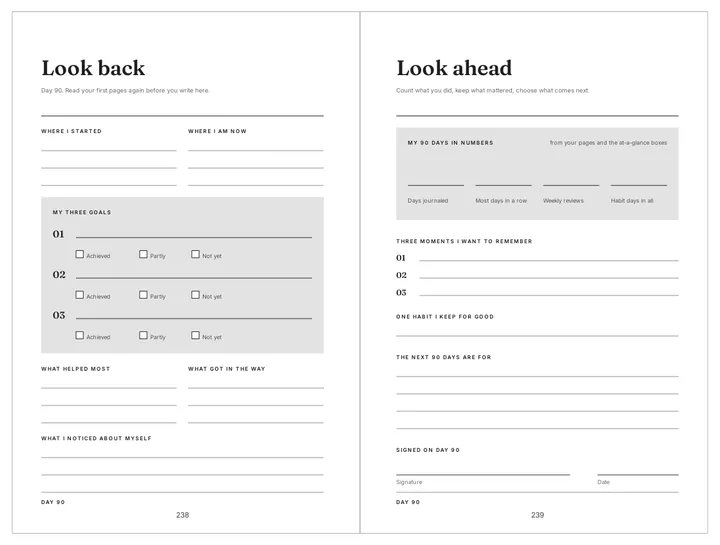
The same idea in other journals
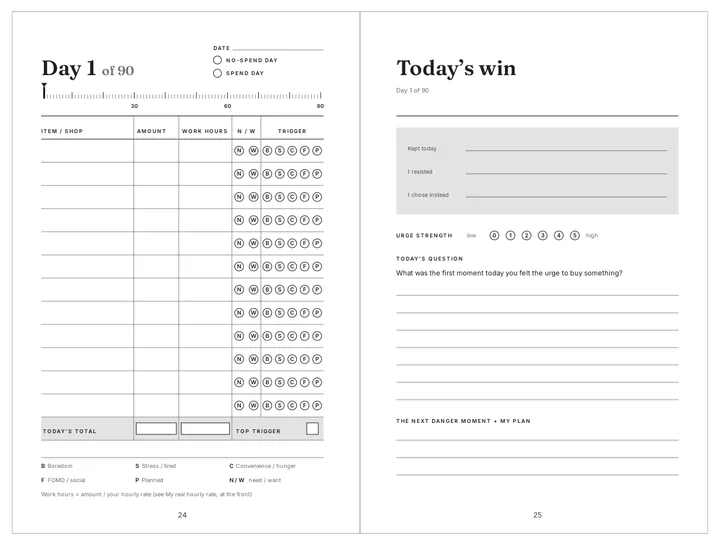
The checkpoints are not unique to one book. The 90 Day Sleep Reset Journal stops at night 30 and night 60, and so does The 90 Day No-Spend Journal, where you add up what you kept, see which of your rules held, and write the rules for the next thirty days. Each journal’s page lists what is inside.