Keeping a sleep diary for ninety nights: what the pages ask
A tour of The 90 Day Sleep Reset Journal: the evening page, the two-minute morning log, the wake-time map and the weekly review. Not medical advice.
This article describes how the pages of a journal work. It is not medical advice, and it does not tell you how long to sleep or when to go to bed. If you have ongoing trouble sleeping, talk to a doctor.
A sleep diary is a simple idea: write down what the night was like, every day, so that you and the person who helps you can read the pattern. The 90 Day Sleep Reset Journal is laid out as a sleep diary for CBT-I (cognitive behavioral therapy for insomnia), over ninety nights. This is a tour of what you do on each page.
First, what the book says about itself
The book calls itself a self-help tool, not medical care. It prints a “Before you start” page with a short list of situations where it says to talk to a doctor first, for example loud snoring with gasping, pregnancy, shift work, driving for a living, or taking sleep medication. It also says that a plan from your doctor, sleep clinician or sleep program always comes first.
If you already work with a clinician, bring the journal to them and ask how they want you to use it. The pages below are the diary part. Anything about changing your sleep schedule is for you and your care team to decide, not for a blog post.
One night, two pages
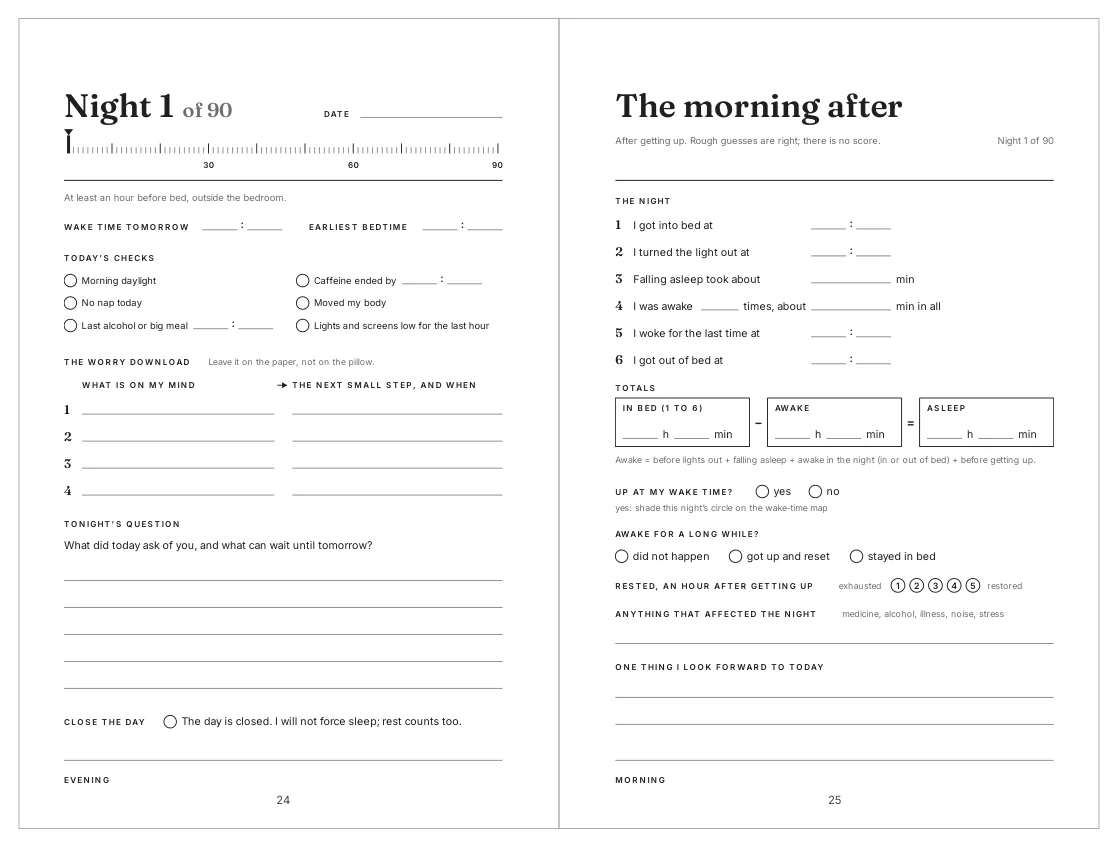
The unit of the book is the night. Every night is a two-page spread headed “Night N of 90”: the left page is the evening before, and the right page is the morning after.
The evening page is meant to be done at least an hour before bed, outside the bedroom. It asks for your wake time tomorrow and your earliest bedtime, then a short row of checks to tick, such as morning daylight, no nap today, caffeine ended by a time you write in, whether you moved your body, and lights and screens low for the last hour.
The middle of the page is the worry download, with the note “Leave it on the paper, not on the pillow.” There are four rows. On each you write what is on your mind, and the next small step and when you will take it. After that comes the night’s question and a line to close the day: “The day is closed. I will not force sleep; rest counts too.”
The day is closed. I will not force sleep; rest counts too.
The morning page is a two-minute log, written after you get up and from memory. Its note says rough guesses are right and there is no score. You write when you got into bed, when the light went out, how long falling asleep took, how many times you were awake and for about how long, when you woke for the last time, and when you got out of bed. A small sum then gives the totals. The book’s own example: into bed at 11:40 p.m. and out at 6:30 a.m. is 6 h 50 in bed; awake 20 + 25 + 15 minutes is 1 h; asleep is 5 h 50.
The page ends with a few softer questions: whether anything affected the night (medicine, alcohol, illness, noise or stress), how rested you felt an hour after getting up, from exhausted to restored, and one thing you look forward to today.
The wake-time map
Two pages near the front hold ninety circles. You shade circle N when you got out of bed within fifteen minutes of your wake time after night N, however the night went. A circle for a night you did not manage stays empty.
This is a quiet design choice. The map rewards something you did, not how well you slept, so there is nothing to be disappointed about at six in the morning.
Every seven nights, and at night 30 and 60
After each seventh night, a weekly review adds up the week and works out your sleep efficiency. Week 1 is a baseline: you log and do not change anything. After that, the journal’s window rule says whether to move your bedtime. That is the part to read with your doctor or sleep clinician if you work with one, because it is a rule about your schedule.
At night 30 and night 60 the journal stops for a checkpoint, where you fill in a column of your starting numbers. After night 90 come The last count, Look back and Look ahead.
If you miss a night
Leave it blank and pick up tonight. The book’s footer says so in those words. A gap in a diary is still information, and a diary filled in from memory a week later is less use than one with a few honest blanks.
What the journal does not do
It does not promise sleep, and it does not diagnose anything. It gives you a place to put the day down in the evening and the night in the morning, in the same order, for ninety nights. Whether you use it alone or alongside professional help is up to you, and the book says that professional help comes first.