How to use a 90 day journal, from the first page to day 90
A plain walkthrough of a 90 day journal: the start pages, the daily spread, the weekly review, the checkpoints, and what to do when you miss a day.
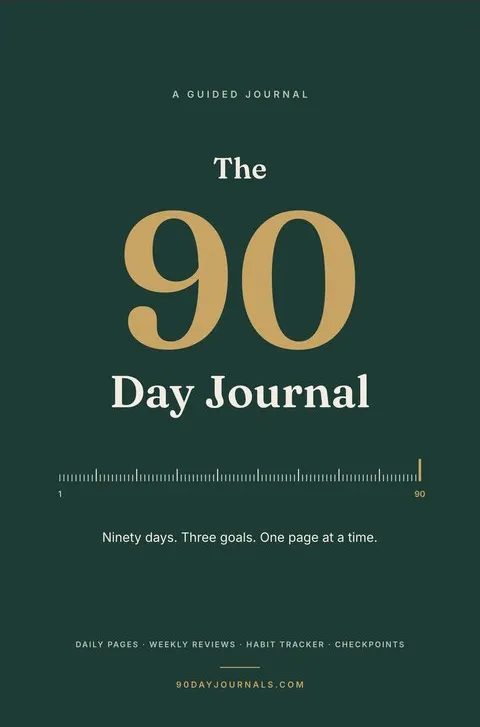
A 90 day journal is a long book with a short daily ask. Ninety days is a lot of pages, so it helps to know the shape of the whole run before you begin. This is a walkthrough of that shape, using The 90 Day Journal, the first book of the series. The other journals follow the same rhythm, each laid out for its own topic.
Start with the first pages, not day 1
The eight start pages come before day 1, and they are worth doing in one unhurried sitting. In The 90 Day Journal they ask where you stand now and why it matters to you, then set up the rest of the book:
- Three goals. Each goal has a “Done when” line, so you can tell whether it is finished, and a “First step”, so it starts this week.
- Five habits. You name them once, as H1 to H5, and never write the names again.
- Starting numbers. What you measure, with a target and columns for day 1, day 30, day 60 and day 90.
- Obstacles and support. Three “if this happens, I will do that” plans, written while you are calm.
- What you say no to, and a plan for week 1.
A practical tip: keep the goals small enough to finish. The page has room for three, and no more, on purpose.
The daily spread: five minutes morning, five evening
Every day has a two-page spread. The back cover asks for five minutes in the morning and five in the evening, and that is the whole commitment.
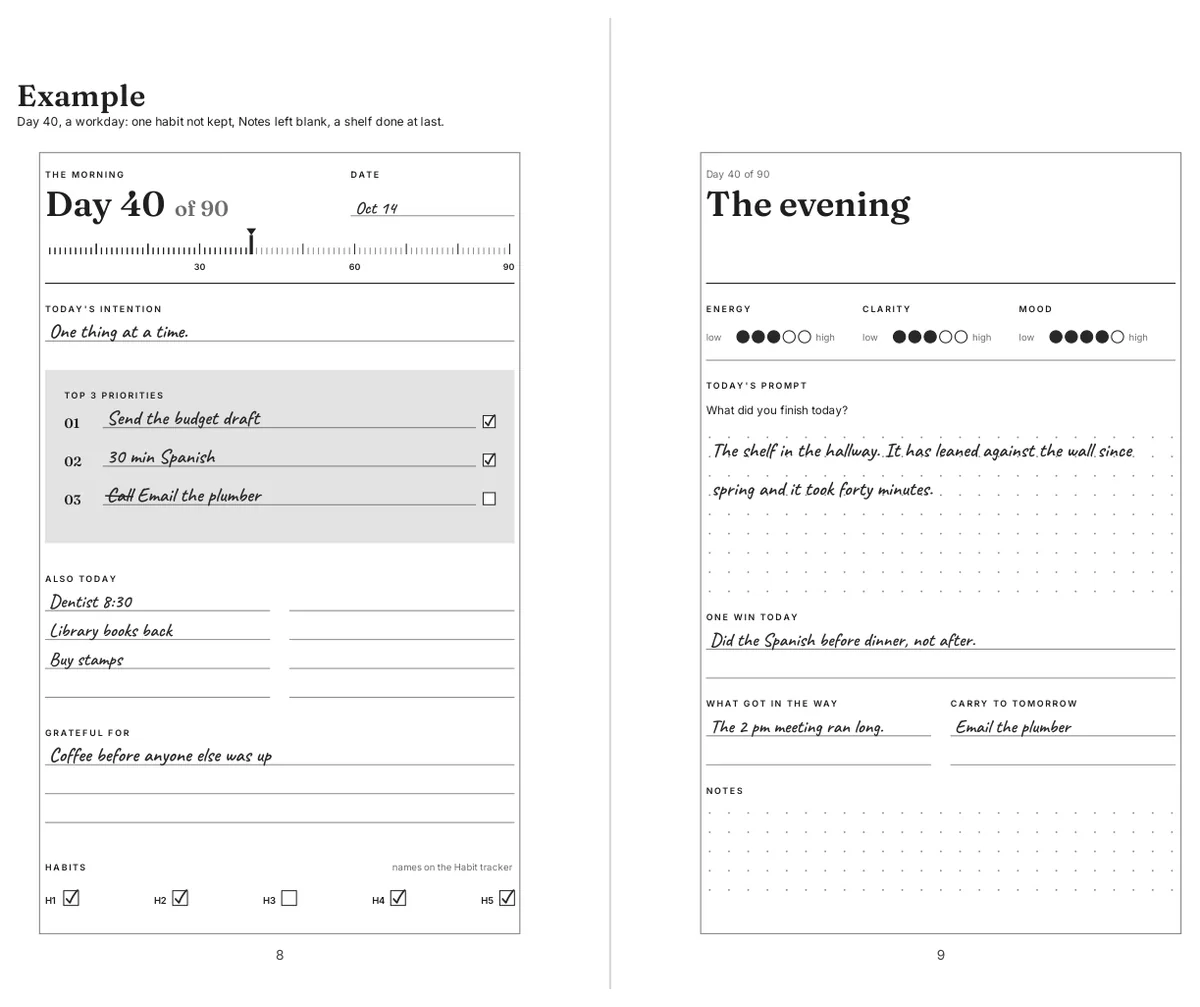
The morning page (left) is the plan. You write one line for today’s intention, your top three priorities, whatever else is on today, and a line of thanks. Each priority has a box to tick later, and five small boxes are waiting for your habits.
The evening page (right) is mostly writing. You rate energy, clarity and mood on a row of five circles, answer a question that is different every day, and write one win, what got in the way, and what to carry to tomorrow. A Notes area holds whatever did not fit anywhere else.
The questions are worth a mention. There are 90 of them, one per day. Day 7 asks, “One week in: what stands out from the first seven days?” Day 30 asks, “What have the first 30 days shown you?” Two sentences are a real answer.
In the evening, tick the priorities you finished and the habits you kept, then fill the matching squares on the habit tracker at the front of the book. That is the only tally you need to keep.
The weekly review: look back every seventh day
After every seventh day, two pages ask you to look back at the week. You write down wins and your best moment, what got in the way, and what you will do differently. You count your habit days out of seven and the top-three priorities you finished. Then you set your top three and a focus for the next seven days.
There are thirteen of them. Week 13 is short, with six days, and it ends with a count of all ninety.
One suggestion: read the week’s evening pages before you write the review. You are summarizing what you actually wrote, not what you remember.
Checkpoints on day 30 and day 60
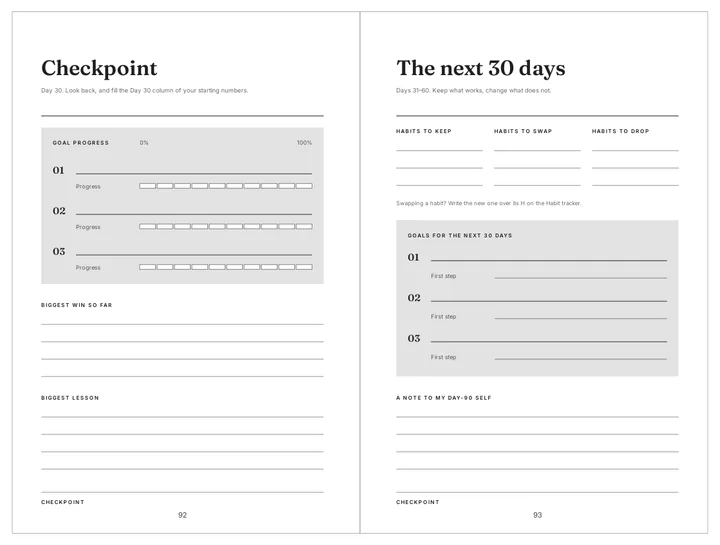
Twice, the journal stops you for a checkpoint. You shade your progress on each of your three goals, fill in your starting numbers again, and decide which habits to keep, swap or drop. Then you set goals for the next thirty days.
Changing the plan at a checkpoint is not failure. It is what the pages are for.
When you miss a day
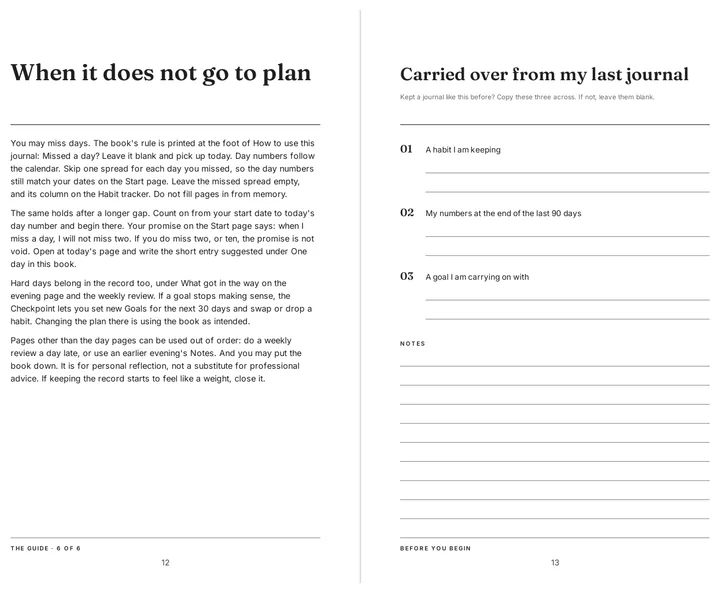
You will miss days. The rule printed in the book is simple: leave it blank and pick up today. Nothing needs catching up.
A few details help:
- Day numbers follow the calendar. Skip the spread of the day you missed rather than filling it in from memory.
- After a longer gap, count on from your start date and begin at today’s day number.
- The promise on the start page is modest: when I miss a day, I will not miss two.
- On a bad day, write less. The book’s own guide suggests the date, the boxes for any habits you kept, and one win. The rest can stay empty.
Day 90: look back, look ahead
The last pages, Look back and Look ahead, ask you to read your first pages again, compare with your starting numbers, and decide what the next ninety days are for. Because the record is in your own handwriting, you are reading it, not guessing at it.
The same rhythm in other journals
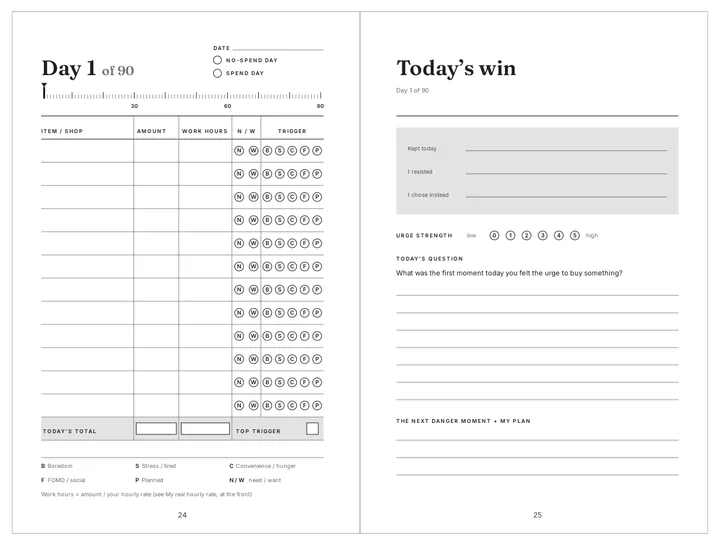
The weekly look-back is not unique to one book. In 22 of the 24 journals in the series, two pages after every seventh day look back at the week. The 90 Day Sleep Reset Journal puts an evening wind-down on the left page and a two-minute log of the night on the right. The 90 Day No-Spend Journal logs purchases on the left page, then a win and the day’s question on the right. Each journal’s page lists what is inside.
The journals are 6 x 9 in paperbacks, sold on Amazon (listings coming soon).