What to do when you miss a day in your journal
You will miss a day sooner or later. The journal's rule: leave it blank and pick up today. How the day numbers work, and what to write after a gap.
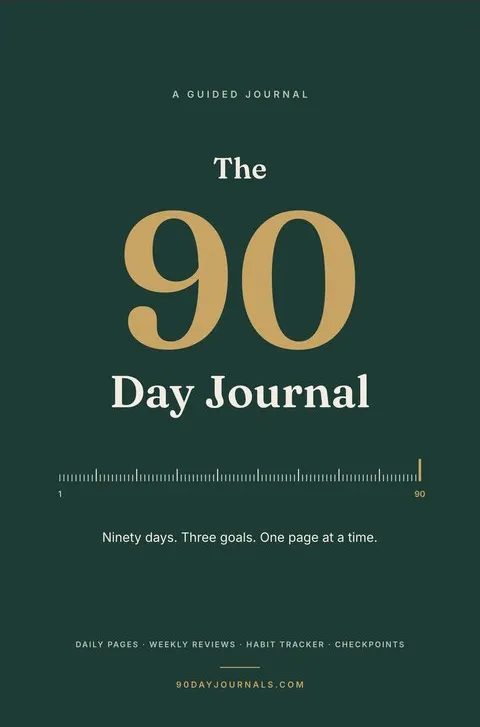
Sooner or later there is a day with no entry. You were away, you were ill, you worked late, or you simply forgot. Ninety days is long enough that a missed day is normal, so it helps to know what the book wants you to do before it happens. This is what The 90 Day Journal says, and how the same idea shows up in two other journals of the series.
The rule is on the first page you read
At the foot of the page “How to use this journal”, in capital letters, is one line:
Missed a day? Leave it blank and pick up today.
That is the whole rule. Nothing needs catching up, and nothing is owed. The sleep journal has the same line, written for nights: “Missed a night? Leave it blank and pick up tonight.”
Day numbers follow the calendar
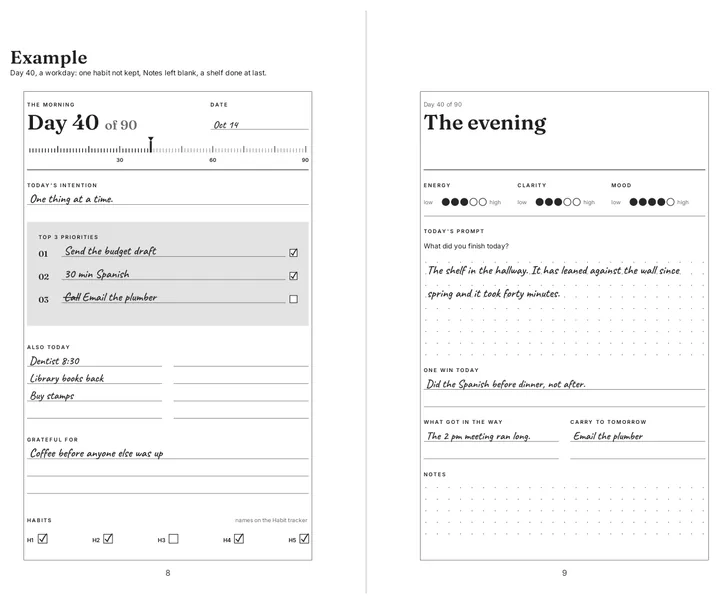
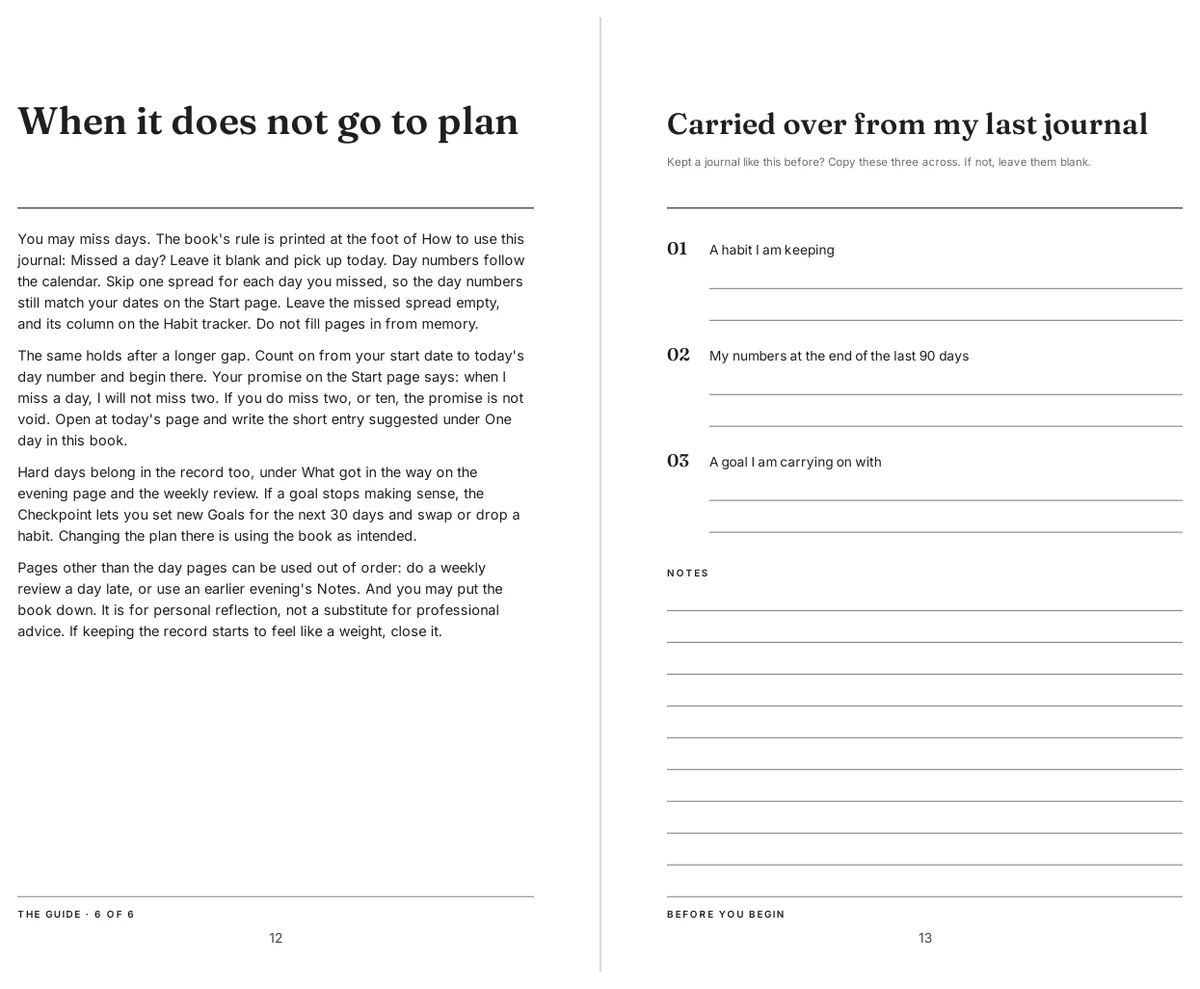
Every day in the journal is a two-page spread headed “Day N of 90”, and the dates you wrote on the Start page tell you which day it is today. So when you miss a day, you skip its spread and leave it empty. The book puts it plainly: skip one spread for each day you missed, so the day numbers still match your dates. Leave the missed spread empty, and its column on the Habit tracker.
After a longer gap, the book says to count on from your start date to today’s day number and begin there. If you started on 1 November and you open the book again on 20 November, you are on day 20. You do not go back.
Why not fill it in afterwards?
The book’s answer is short: do not fill pages in from memory. A journal is useful because it holds what you wrote at the time. Two weeks later you will remember the day differently, usually more tidily, and the record loses the one thing it had.
There is also a kinder reason. A blank day means only that you did not write. It does not say the day was bad, and it is not a mark against you.
On a bad day, write less
The guide has one suggestion for days when you have little time or energy. It is not a rule, just a way to keep the thread:
- the date
- the boxes for any habits you kept, and their squares on the Habit tracker
- the day’s box on its at-a-glance page
- if there is room for one more line, One win today
The rest can stay empty. Those are the marks that the weekly review and the final pages add up later, so a thin entry still counts.
The promise: not twice
On the Start page you write a promise, and its wording is modest: when I miss a day, I will not miss two. The habit rule is the same size: do not aim for a perfect row, aim to never miss twice.
If you do miss two, or ten, the promise is not void. Open the book at today’s page and write the short entry above. That is the restart.
Put the hard days on the page too
Missed days often have a reason, and the reason belongs in the record. The evening page has a line for What got in the way, and so does the weekly review. Something like “away since Thursday, back tonight” is a perfectly good entry, and it will explain the empty squares when you read the week back.
The weekly review itself can also slip. The pages other than the day pages can be used out of order, so a review done a day late is still a review.
Other journals, the same idea
- The 90 Day Sleep Reset Journal counts nights, and its footer says to leave a missed night blank and pick up tonight.
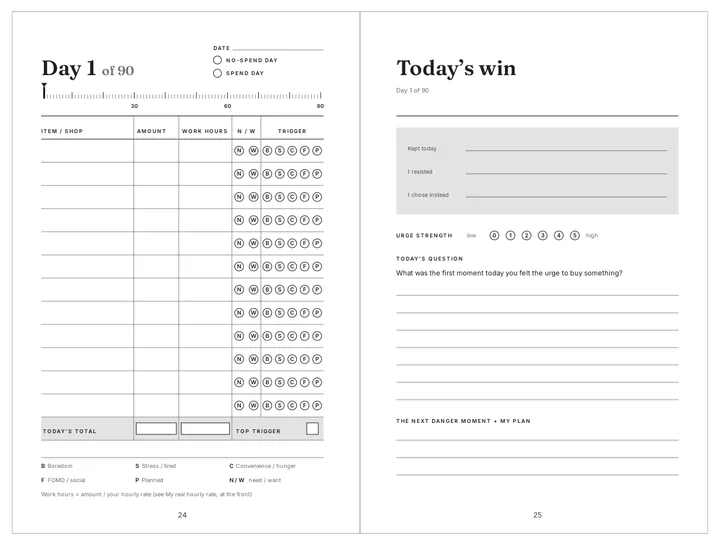
- The 90 Day No-Spend Journal records each day as a no-spend day or a spend day. A spend day leaves its circle on the 90-day path empty: no guilt, no reset.
When the plan is the problem
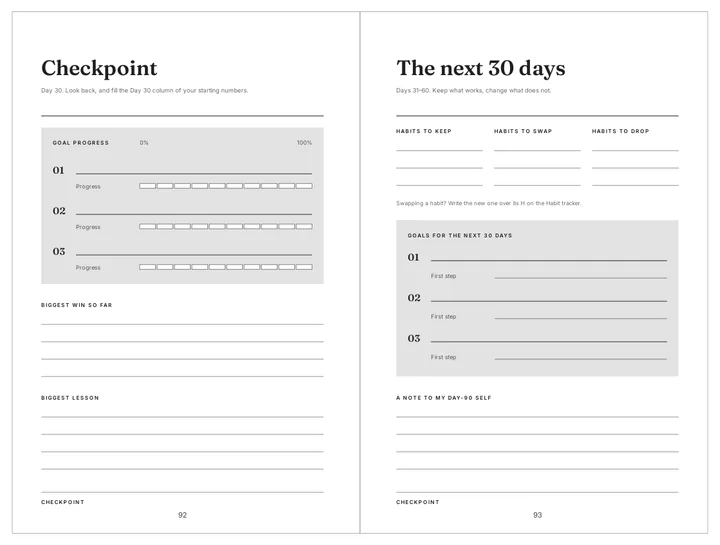
Sometimes the days are not the trouble, the plan is. If a goal stops making sense, you do not have to drag it to day 90. The checkpoints after day 30 and day 60 let you set new goals for the next thirty days and swap or drop a habit. The book says that changing the plan there is using it as intended.
And you may put the book down. It is for personal reflection, and if keeping the record starts to feel like a weight, the book itself says to close it. You can open it again whenever you like, at today’s page.
If you are new to the journal, the walkthrough How to use a 90 day journal, from the first page to day 90 shows where each of these pages sits.