Why write it on paper: five practical reasons
Why a ninety-day journal is a printed book and not an app: a page with limits, no notifications, a record you can flip through, and an end in sight.
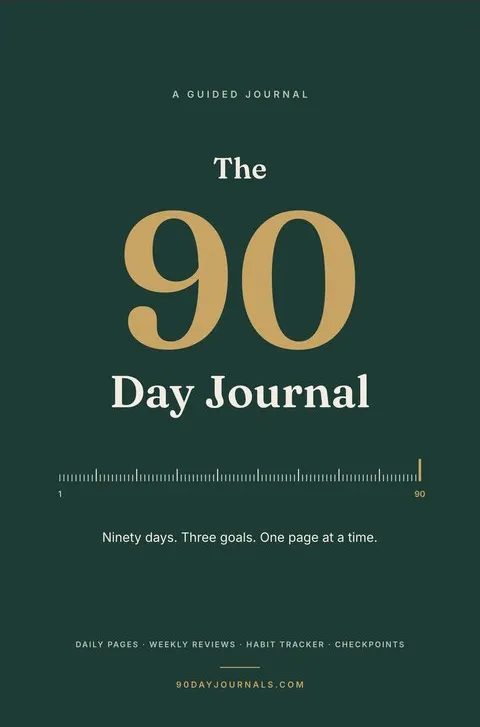
There are plenty of good apps for habits, goals and notes. So why would anyone keep a ninety-day journal on paper? There is no single right answer, and some people will always prefer a screen. But there are practical reasons, and they come from what a printed page actually is and from how the 90 Day Journals are laid out.
1. A page has limits
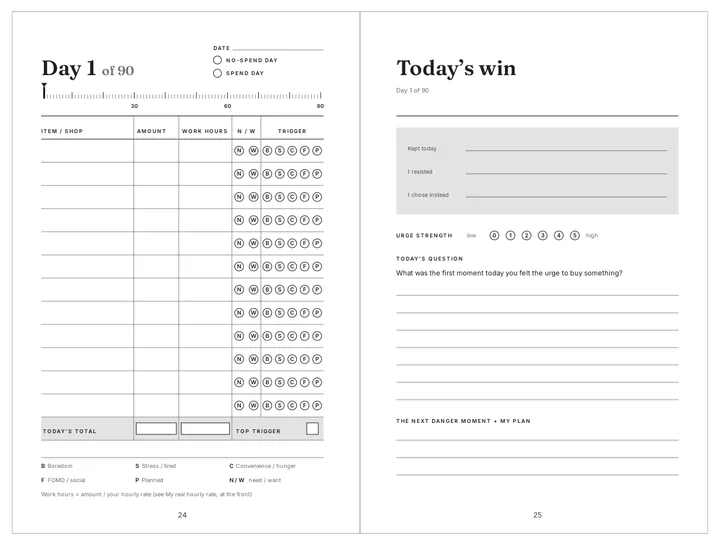
A screen can scroll forever. A page cannot. The first pages of The 90 Day Journal have room for three goals, and the book says why: the page has no room for a fourth. The same goes for the three priorities on every morning page, and the five habit boxes.
Those limits do some of the deciding for you. You cannot add a tenth priority, so you choose three. In a journal that asks for small, regular entries, a limit that is built into the paper is easier to keep than a limit you have to remember.
2. Nothing else is on the page
A journal on paper has no notifications, no tabs, and no message that arrives while you write your intention for the day. The page holds the page.
That sounds small, but the daily ask in these journals is small too: five minutes in the morning and five in the evening. Five minutes is easy to lose to a phone. A book that sits on the desk or the bedside table, open to today, takes up very little of your attention until you pick up the pen.
3. You can see all ninety days at once
A record is only useful if you can read it back. On paper, “reading it back” means turning pages. The Habit tracker shows the whole run on a few pages, and the book points out that gaps show as shapes: a column that is empty for all five habits, or a row that thins out at the end of every block.
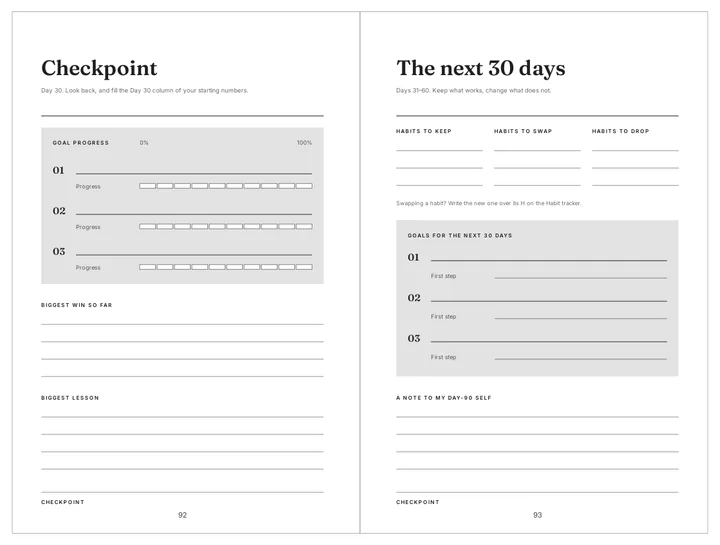
The weekly review works the same way. You can lay four weeks side by side on a table, or hold the first checkpoint’s shaded bars next to the second’s. At day 90, Look back asks you to read your first pages again before you write, and they are right there, where you left them.
4. It is your own handwriting
The book’s phrase for what you gain is “a record in your own handwriting: what you meant to do each morning, what you did, how your energy and mood ran, and one win for every day you wrote.”
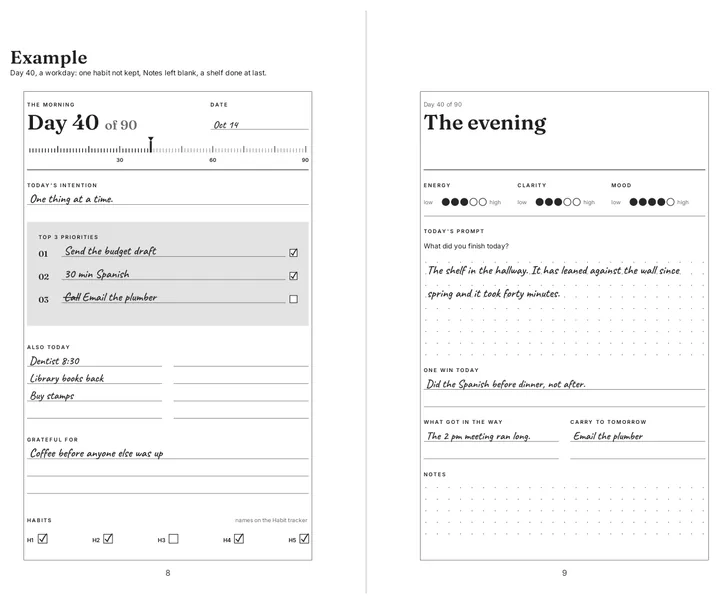
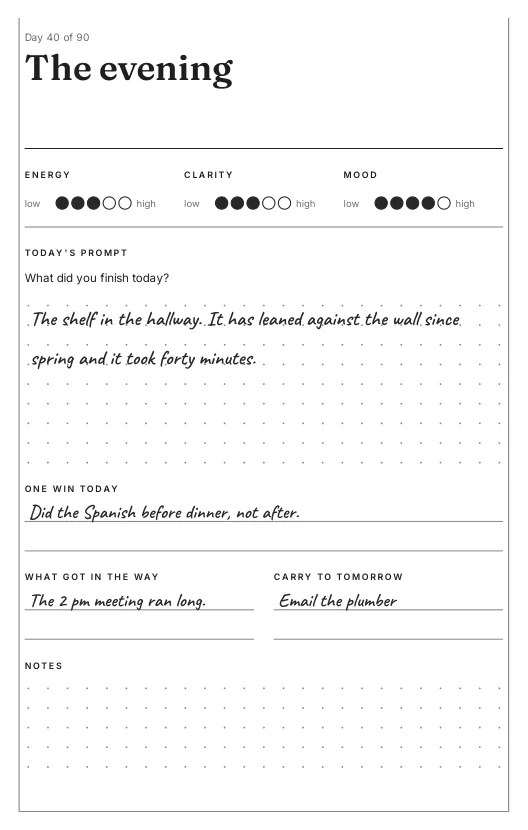
Handwriting also lets the page be imperfect. The example day printed in the book is filled in by hand, and it is not complete: some fields are blank and a word is crossed out. A crossed-out word is not an error. It is what a real day looks like, and the journal never asks for a perfect page. It asks for the rhythm.
The rhythm matters more than perfect pages.
5. It has an end
A notes app has no last page. A ninety-day journal does. Day 90 arrives, there is a final spread, and then you close the book and put it on a shelf. Having an end can change how a bad week feels: it is one stretch of a finite thing, not a failure of an endless one.
It also gives you something to keep. A shelf of finished journals is a record of ninety-day stretches, each in its own hand. Nothing needs an account or a password, and nothing needs to be exported.
When paper is not the answer
Paper has costs, too. A book can be lost, it cannot be searched, and it is not always with you. If you would rather keep your notes in an app, a journal on paper will not change that. There is also nothing wrong with doing both, for example by taking a photo of a page you want to remember.
The journals are laid out for people who want to try the paper version for one stretch of ninety days and see what it is like. They are 6 x 9 in paperbacks, sold on Amazon (listings coming soon). If you are not sure where to begin, the walkthrough How to use a 90 day journal, from the first page to day 90 shows the whole shape.